51 Reviews
5.0
★★★★★

Fayetteville Truck Accident Lawyer

Lawyers for Fayetteville Truck Accidents

A truck accident can leave you facing severe injuries, overwhelming medical bills, lost income, vehicle damage, and an aggressive insurance response from the trucking company.

Because commercial trucks are larger and heavier than passenger vehicles, these crashes are more likely to cause catastrophic injuries and long-term consequences.

Whether you were hit by a tractor-trailer on I-49, involved in a commercial truck crash near Fayetteville’s industrial or retail corridors, or injured anywhere in Northwest Arkansas, you deserve clear answers and experienced legal support.

At NWA Car Accident Attorney, our Fayetteville Truck Accident Lawyers help injured people understand their rights, investigate trucking company negligence, and pursue compensation after serious commercial vehicle crashes.

Our legal team can review the crash, preserve important trucking records, identify every responsible party, and help you seek the compensation available under Arkansas law.

Fayetteville Motor Vehicle Accident Lawyers; Fayetteville Car Accident Lawyers; Fayetteville Truck Accident Lawyers; Fayetteville Motorcycle Accident Lawyers; Fayetteville Uber Accident Lawyers

Injured in a Truck Accident in Fayetteville?

A truck accident can be physically and emotionally devastating.

Victims may require emergency treatment, surgery, rehabilitation, and months or years of follow-up care while also dealing with lost wages and pressure from trucking company insurers.

If you were injured in a truck crash in Fayetteville, Arkansas, an experienced Fayetteville truck accident lawyer can help you understand your legal rights and determine whether you may have a claim.

Depending on the circumstances, you may be able to seek compensation for medical expenses, lost income, pain and suffering, property damage, permanent disability, and other losses caused by a negligent truck driver, trucking company, or another liable party.

At NWA Car Accident Attorney, we understand how difficult life can become after a serious commercial truck accident.

Our attorneys can investigate what happened, obtain driver logs and maintenance records, preserve electronic data, handle communication with insurance adjusters, and work to hold the responsible parties accountable.

Contact our Northwest Arkansas truck accident attorneys today for a free consultation, or use the chat feature on this page to see whether you may qualify to file a Fayetteville truck accident claim.

We are ready to help you protect your rights and take the next step toward recovery.

Why Truck Accident Cases Are Different From Other Motor Vehicle Accidents

Truck accident cases are often more complicated than ordinary car accidents because large commercial trucks are subject to additional federal regulations, industry standards, maintenance requirements, and insurance policies.

A collision involving a fully loaded semi truck may also cause far greater damage than a crash between two passenger vehicles.
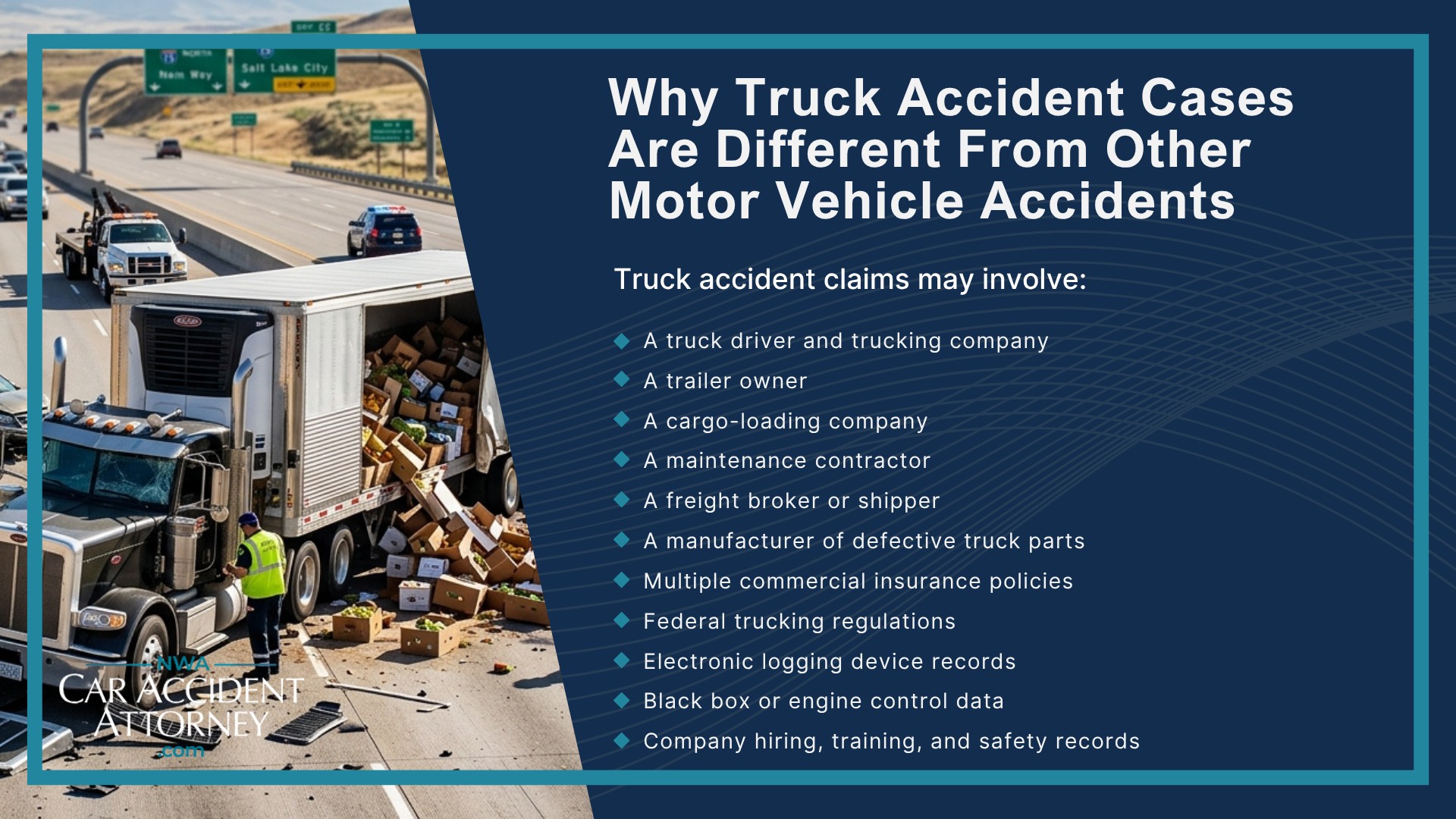
Truck accident claims may involve:

  • A truck driver and trucking company
  • A trailer owner
  • A cargo-loading company
  • A maintenance contractor
  • A freight broker or shipper
  • A manufacturer of defective truck parts
  • Multiple commercial insurance policies
  • Federal trucking regulations
  • Electronic logging device records
  • Black box or engine control data
  • Company hiring, training, and safety records

Truck accident victims may suffer catastrophic injuries, permanent disabilities, or wrongful death.

An experienced truck accident attorney can investigate every potentially responsible party and protect evidence that negligent trucking companies may otherwise control.

Many for-hire interstate motor carriers operating commercial vehicles weighing 10,001 pounds or more must maintain at least $750,000 in public liability coverage.

Certain operations involving oil or hazardous materials are subject to higher federal minimums, and the actual available coverage may include multiple policies or limits above the federal minimum.

Common Causes of Truck Accidents in Fayetteville

Truck accidents caused by negligence may involve mistakes made by the truck driver, unsafe company practices, poor vehicle maintenance, or improperly loaded cargo.

In many truck accident cases, more than one failure contributes to the crash.
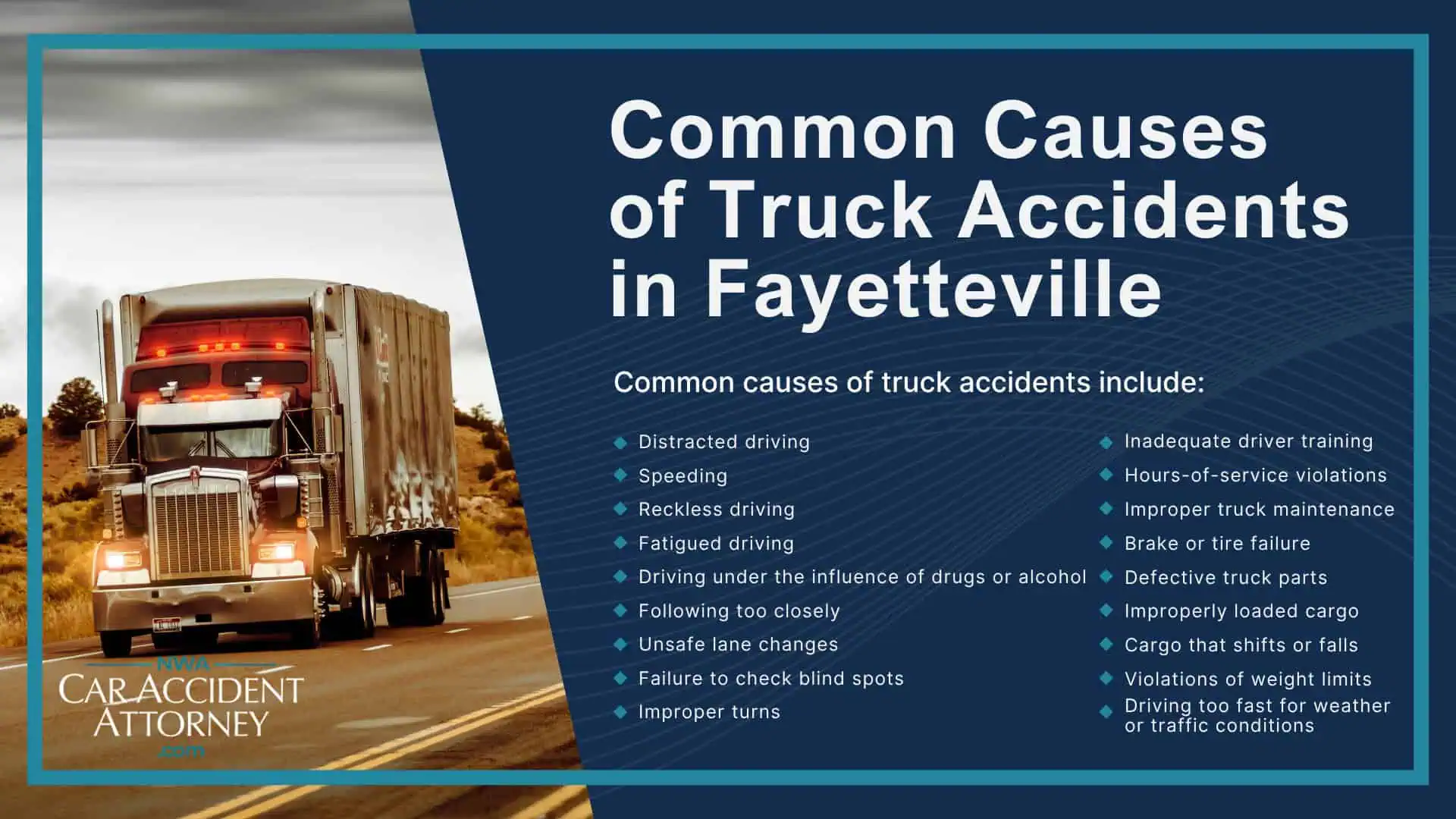
Common causes of truck accidents include:

  • Distracted driving
  • Speeding
  • Reckless driving
  • Fatigued driving
  • Driving under the influence of drugs or alcohol
  • Following too closely
  • Unsafe lane changes
  • Failure to check blind spots
  • Improper turns
  • Inadequate driver training
  • Hours-of-service violations
  • Improper truck maintenance
  • Brake or tire failure
  • Defective truck parts
  • Improperly loaded cargo
  • Cargo that shifts or falls
  • Violations of weight limits
  • Driving too fast for weather or traffic conditions

Large trucks require more distance to stop and more room to turn than passenger vehicles.

When a truck driver or trucking company ignores those limitations, the results may include a semi truck crash, rollover accident, jackknife collision, or fatal crash.

Dangerous Highways and Truck Routes in Fayetteville and Northwest Arkansas

Truck accidents in Arkansas may occur wherever commercial vehicles share the road with commuters, students, tourists, and local traffic.

In Fayetteville and Northwest Arkansas, interstate traffic, construction, highway interchanges, and busy commercial corridors can increase the risk of serious accidents involving tractor trailers and other large commercial trucks.
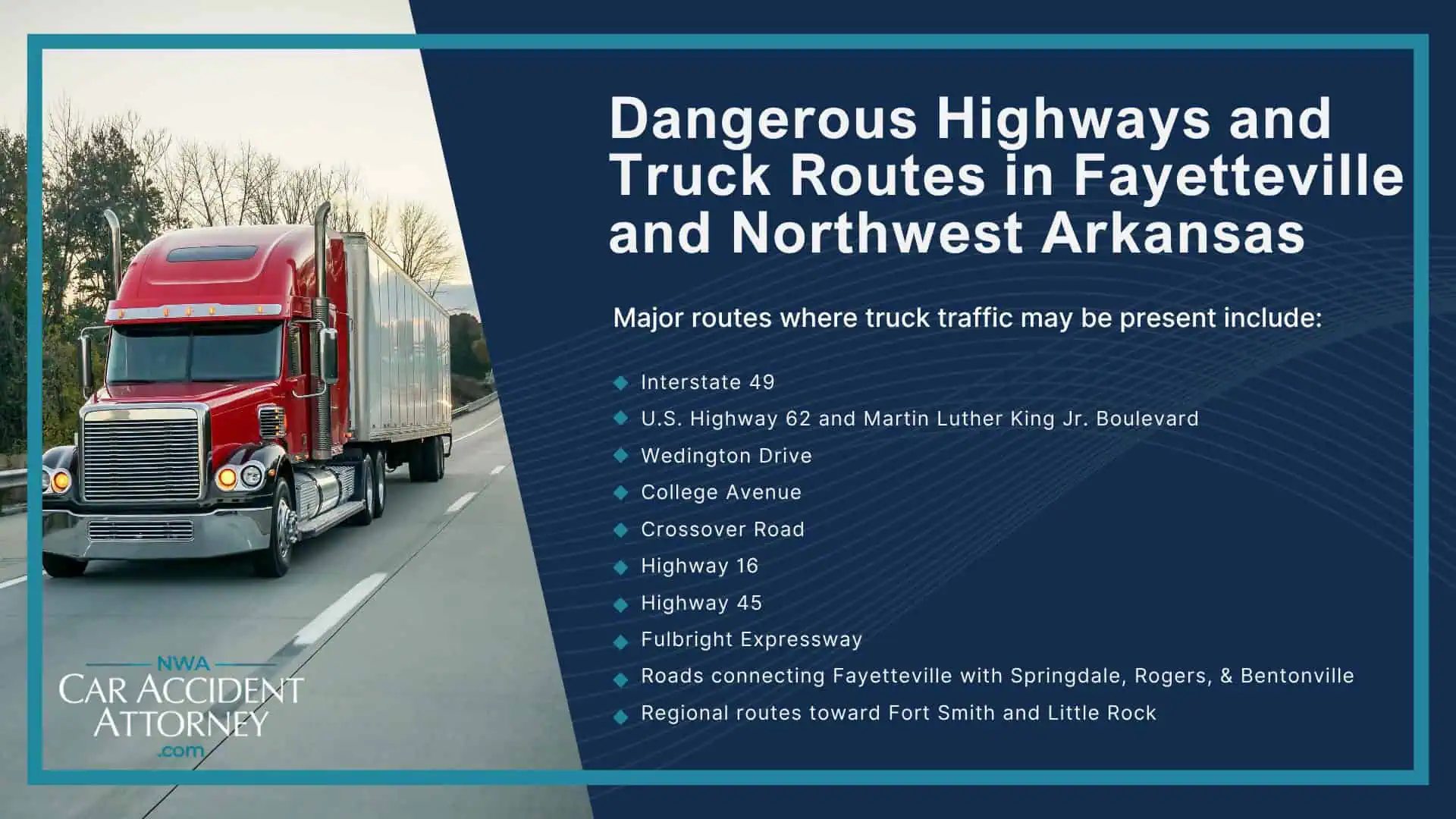
Major routes where truck traffic may be present include:

  • Interstate 49
  • U.S. Highway 62 and Martin Luther King Jr. Boulevard
  • Wedington Drive
  • College Avenue
  • Crossover Road
  • Highway 16
  • Highway 45
  • Fulbright Expressway
  • Roads connecting Fayetteville with Springdale, Rogers, and Bentonville
  • Regional routes toward Fort Smith and Little Rock

The City of Fayetteville has identified active improvement work around the I-49 and Martin Luther King Jr. Boulevard interchange, including Highway 62 widening and interchange reconstruction.

Fayetteville has also referenced improvements near the I-49 and Wedington Drive interchange.

Construction, lane changes, merging traffic, and large commercial vehicles can create additional risks when drivers fail to use reasonable care.

These roads are not presented as an official ranking of dangerous truck routes.

Every truck accident claim must be evaluated based on the accident scene, traffic conditions, vehicle movement, and circumstances involved.
Types of Truck Accident Cases We Handle

Truck accidents can occur in many different ways.

The type of collision may affect fault, the available evidence, and the severity of the truck accident injuries.

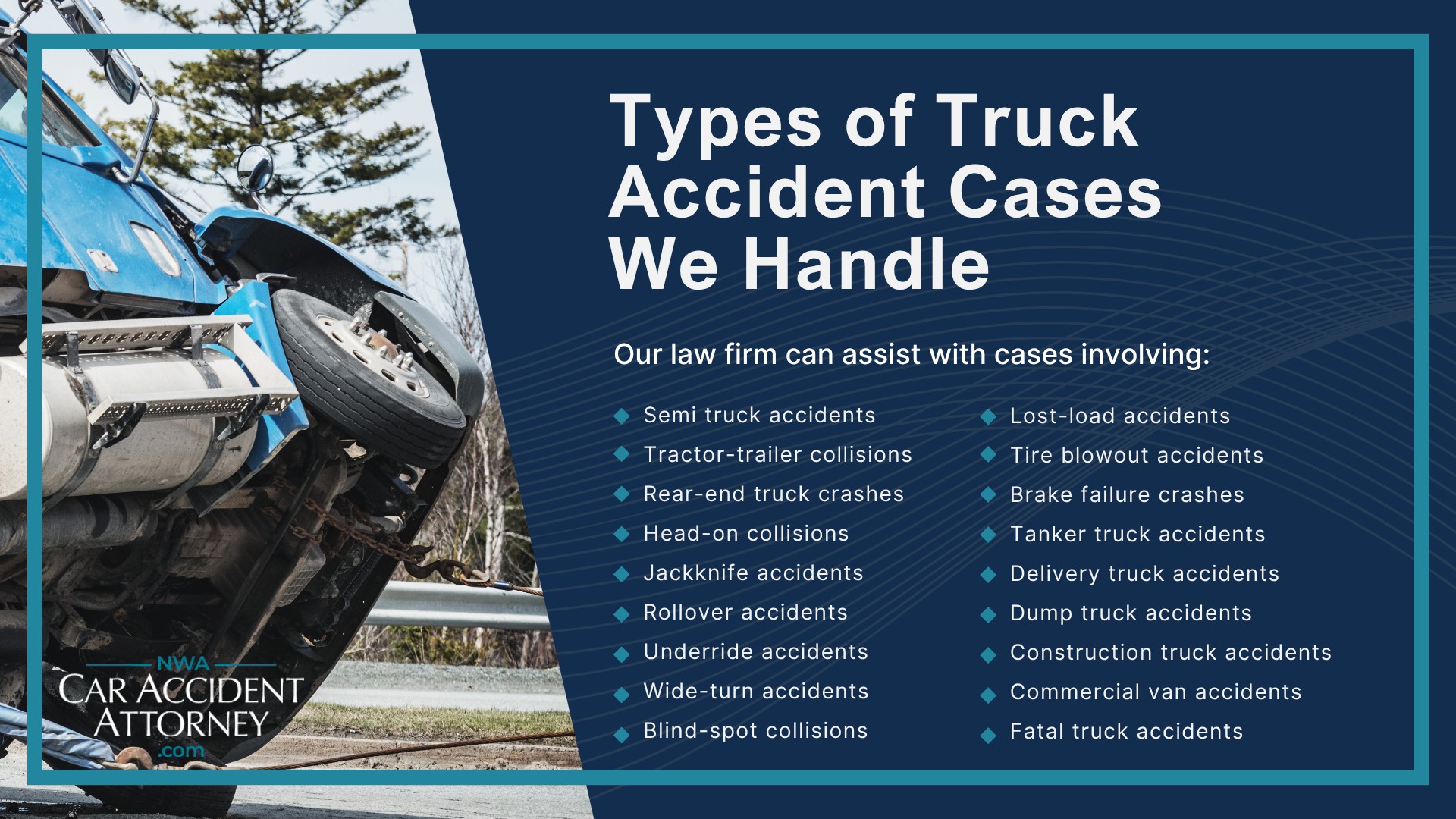
Our law firm can assist with cases involving:

  • Semi truck accidents
  • Tractor-trailer collisions
  • Rear-end truck crashes
  • Head-on collisions
  • Jackknife accidents
  • Rollover accidents
  • Underride accidents
  • Wide-turn accidents
  • Blind-spot collisions
  • Lost-load accidents
  • Tire blowout accidents
  • Brake failure crashes
  • Tanker truck accidents
  • Delivery truck accidents
  • Dump truck accidents
  • Construction truck accidents
  • Commercial van accidents
  • Fatal truck accidents

An Arkansas truck accident attorney can evaluate whether the crash involved driver negligence, federal trucking laws, unsafe company practices, defective equipment, or multiple liable parties.

Common Truck Accident Injuries

Because semi trucks and tractor trailers are much heavier than passenger vehicles, people inside smaller vehicles may suffer severe injuries even when the truck driver is not seriously hurt.

Some truck accident victims require emergency surgery, long-term rehabilitation, or lifelong medical care.

Common truck accident injuries include:

  • Traumatic brain injuries
  • Spinal cord injuries
  • Paralysis
  • Internal injuries
  • Organ damage
  • Broken bones
  • Crush injuries
  • Severe neck and back injuries
  • Nerve damage
  • Amputations
  • Burns
  • Scarring and disfigurement
  • Chronic pain
  • Psychological trauma
  • Emotional distress

Some crashes cause vehicles to catch fire, exposing occupants to burn injuries and smoke inhalation.

Other truck accident injuries may have delayed symptoms, making prompt medical care and follow-up treatment important.

Medical records, diagnostic imaging, surgical reports, therapy notes, and medical bills may help establish the extent of the injuries and their effect on the victim’s future.

Federal Trucking Regulations That May Affect Your Case

The trucking industry is regulated by the Federal Motor Carrier Safety Administration, commonly called the FMCSA.

Federal trucking regulations govern areas such as driver qualifications, hours of service, electronic logging, vehicle maintenance, cargo securement, and drug and alcohol testing.

Depending on the facts, a truck accident claim may involve violations related to:

  • Driver licensing and qualifications
  • Hours of service
  • Electronic logging devices
  • Vehicle inspections
  • Brake and tire maintenance
  • Cargo securement
  • Weight limits
  • Drug and alcohol testing
  • Driver training
  • Recordkeeping
  • Safe operation of commercial vehicles

FMCSA regulations require motor carriers to systematically inspect, repair, and maintain commercial motor vehicles under their control.

Parts and accessories affecting safe operation must remain in safe and proper working condition.

FMCSA cargo rules are intended to prevent loads from leaking, spilling, shifting, blowing, or falling from a commercial vehicle.

Evidence that cargo was improperly secured may support liability when it contributes to a crash.

A violation of a safety regulation does not automatically decide every lawsuit, but it may become important evidence when determining whether the truck driver or trucking company acted negligently.

Truck Driver Hours-of-Service and Fatigue Rules

Truck driver fatigue is a major concern because commercial drivers may spend long hours on the road under delivery pressure.

Federal hours-of-service rules restrict how long many property-carrying drivers may drive and remain on duty.

Under the general FMCSA rules for property-carrying drivers, a driver may drive up to 11 hours after 10 consecutive hours off duty.

Driving is generally prohibited beyond the 14th consecutive hour after coming on duty, and a 30-minute break is generally required after eight cumulative hours of driving without a qualifying interruption.

Exceptions may apply depending on the driver, route, cargo, or operating conditions.

Electronic logging devices are used by many motor carriers to record driving time and off-duty time.

The ELD rule applies to most drivers and carriers that are required to keep records of duty status.

Evidence of fatigue may include:

  • Hours-of-service records
  • ELD data
  • Dispatch communications
  • Fuel receipts
  • Toll records
  • Bills of lading
  • GPS history
  • Delivery schedules
  • Hotel or rest records
  • Driver statements
  • Cell phone records

An experienced truck accident lawyer can compare these records to determine whether the driver exceeded legal limits, falsified logs, or continued driving despite being too tired to operate safely.

Who May Be Liable for a Truck Accident?

A truck accident may involve multiple parties, and identifying each one can be essential to recovering fair compensation.

The truck driver is not necessarily the only person or business that may be held liable.

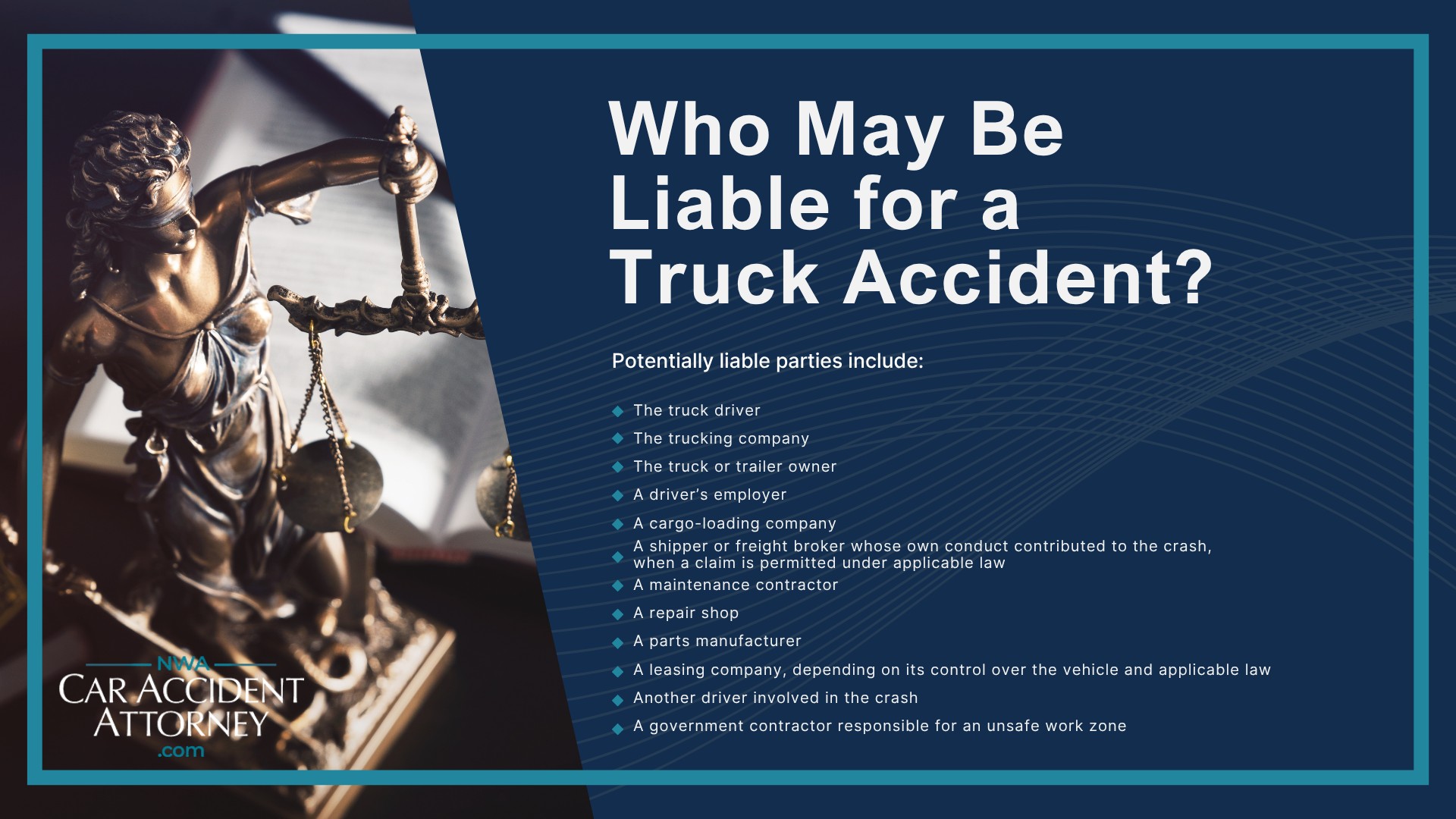
Potentially liable parties include:

  • The truck driver
  • The trucking company
  • The truck or trailer owner
  • A driver’s employer
  • A cargo-loading company
  • A shipper or freight broker whose own conduct contributed to the crash, when a claim is permitted under applicable law
  • A maintenance contractor
  • A repair shop
  • A parts manufacturer
  • A leasing company, depending on its control over the vehicle and applicable law
  • Another driver involved in the crash
  • A government contractor responsible for an unsafe work zone

A vehicle owner may also face liability in certain circumstances, such as when the owner allows an unsafe or unqualified person to operate the truck.

An Arkansas truck accident lawyer can examine contracts, ownership records, employment relationships, insurance policies, and federal carrier information to identify every party that may be responsible.

Trucking Company Liability in Arkansas

A trucking company may be held liable when its own negligence contributes to a collision or when its employee causes a crash while acting within the scope of employment.

The specific legal theory depends on the circumstances.

Claims against negligent trucking companies may involve:

  • Negligent hiring
  • Inadequate background checks
  • Negligent driver retention
  • Poor training or supervision
  • Pressure to violate hours-of-service rules
  • Failure to monitor driving records
  • Improper truck maintenance
  • Failure to inspect brakes or tires
  • Allowing an unsafe truck to remain in service
  • Inadequate drug and alcohol testing
  • Failure to secure cargo
  • Violation of federal safety regulations

FMCSA and Department of Transportation rules require many CDL drivers and their employers to comply with drug and alcohol testing requirements.

These rules address testing procedures, timing, and the substances tested.

Trucking companies often begin investigating serious accidents immediately.

Truck accident victims should consider contacting an experienced attorney before critical company records are changed, overwritten, or lost.

How Fault Is Determined in a Fayetteville Truck Accident Case

Fault in a truck accident case is determined by examining how the crash occurred and whether a truck driver, trucking company, or another party violated a legal duty.

A police report may be helpful, but it rarely contains every fact needed to resolve a commercial truck accident claim.

Evidence used to determine fault may include:

  • Photos and videos from the accident scene
  • The police report
  • Witness statements
  • Traffic citations
  • Truck and passenger vehicle damage
  • Skid marks and debris
  • Dashcam or surveillance footage
  • ELD records
  • Engine control module data
  • Driver logs
  • Maintenance and inspection records
  • Cargo records
  • Driver qualification files
  • Dispatch communications
  • Drug and alcohol testing records
  • Accident reconstruction analysis

Arkansas follows a modified comparative fault rule.

Under Arkansas Code § 16-64-122, fault is compared between the person seeking compensation and the party or parties from whom compensation is sought.

A claimant may recover when the claimant’s fault is less than the fault chargeable to the party or parties from whom compensation is sought.

The recovery is reduced according to the claimant’s percentage of fault.

Recovery may be barred when the claimant’s fault is equal to or greater than the fault of the parties being pursued.

Because comparative fault can reduce or eliminate compensation, trucking insurers may try to blame the injured driver.

A Fayetteville truck accident lawyer can challenge unsupported allegations with physical evidence, witness testimony, and trucking records.

Evidence That Can Strengthen a Truck Accident Claim

A truck accident claim may depend on evidence that is held by the trucking company or another commercial party.

Acting quickly may help preserve records before routine deletion policies or vehicle repairs affect their availability.

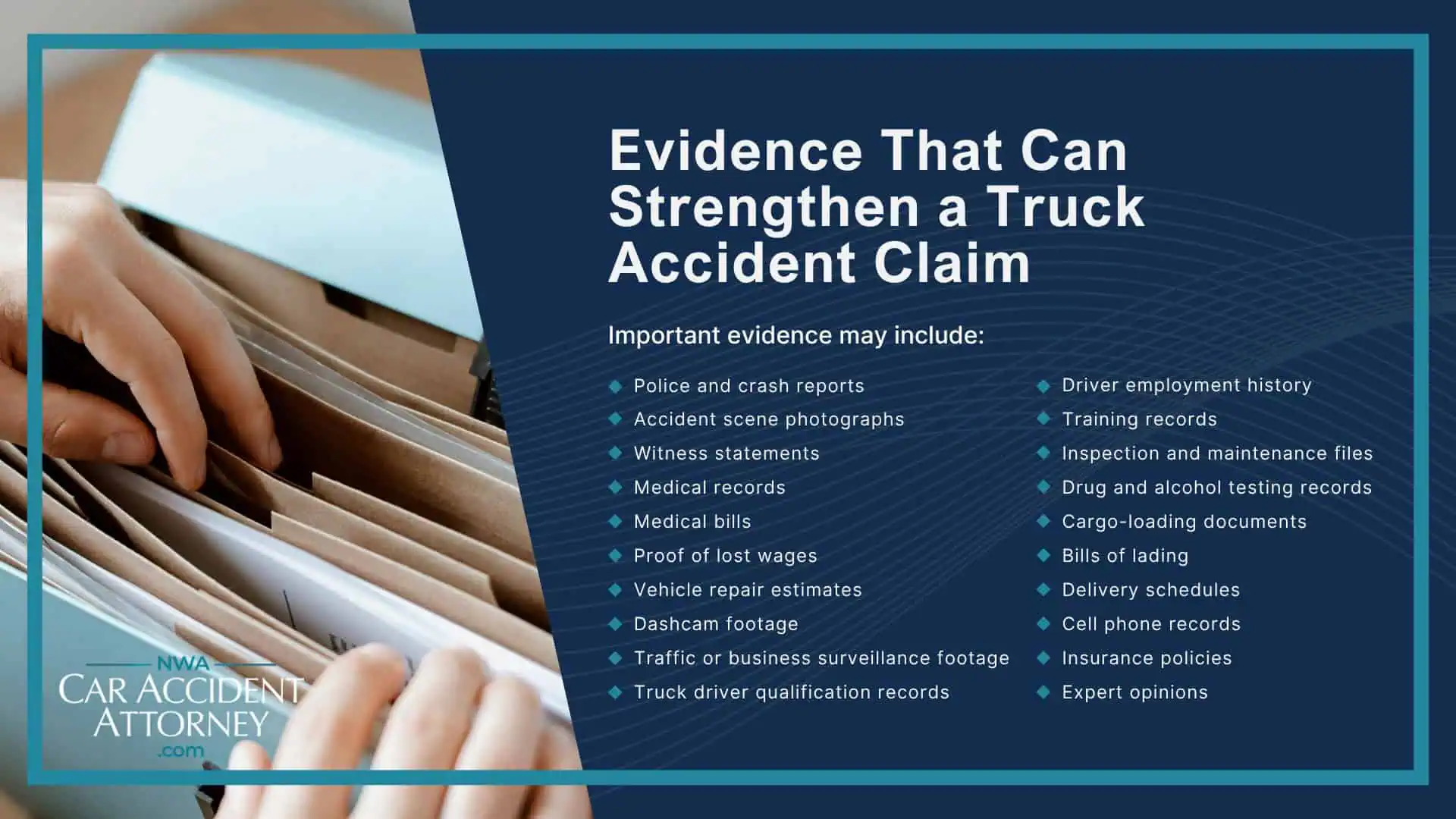
Important evidence may include:

  • Police and crash reports
  • Accident scene photographs
  • Witness statements
  • Medical records
  • Medical bills
  • Proof of lost wages
  • Vehicle repair estimates
  • Dashcam footage
  • Traffic or business surveillance footage
  • Truck driver qualification records
  • Driver employment history
  • Training records
  • Inspection and maintenance files
  • Drug and alcohol testing records
  • Cargo-loading documents
  • Bills of lading
  • Delivery schedules
  • Cell phone records
  • Insurance policies
  • Expert opinions

Truck accident attorneys may send preservation letters instructing the trucking company and its insurer not to destroy relevant evidence.

A legal team can also use formal discovery after a lawsuit is filed to obtain records that are not voluntarily produced.

Black Box Data, Driver Logs, and Other Critical Evidence

Commercial trucks may contain electronic systems capable of recording information about vehicle operation.

Depending on the truck, electronic control module or event data recorder information may show speed, braking, throttle position, engine activity, and other details from the period surrounding a semi truck crash.

Electronic logging devices may also show when the truck driver was operating, resting, or on duty.

FMCSA describes ELDs as tools intended to improve the accuracy and accessibility of driving-time and duty-status records.

Critical trucking evidence may include:

  • Black box or engine control module data
  • ELD records
  • Hours-of-service logs
  • GPS and telematics data
  • In-cab camera footage
  • Dispatch messages
  • Driver inspection reports
  • Maintenance records
  • Brake and tire inspection records
  • Cargo manifests
  • Weigh station records
  • Fuel and toll receipts
  • Cell phone data

Federal inspection rules also require motor carriers to retain certain driver vehicle inspection records for specified periods, and drivers must be satisfied that a commercial vehicle is in safe operating condition before operating it.

This evidence can be overwritten, lost, or altered if it is not preserved quickly.

An experienced truck accident attorney can act promptly to protect it.

What To Do After a Truck Accident in Fayetteville

The aftermath of a truck accident can be chaotic.

Your immediate priorities should be safety, medical care, and reporting the crash.

After a truck accident, try to:

  • Call 911.
  • Request emergency medical assistance.
  • Move away from traffic, leaking fuel, or fire hazards when safe.
  • Seek medical attention even if symptoms appear limited.
  • Report the crash to law enforcement.
  • Photograph the accident scene, vehicles, road, and injuries.
  • Record the truck’s company name and USDOT number.
  • Photograph identifying numbers on the tractor and trailer.
  • Obtain witness names and contact information.
  • Avoid admitting fault.
  • Do not argue with the truck driver or company representative.
  • Preserve damaged property.
  • Keep copies of medical records and bills.
  • Document lost wages and other expenses.
  • Avoid signing insurance releases.
  • Contact a Fayetteville truck accident lawyer promptly.

Do not rely on the trucking company or its insurance carrier to preserve evidence for your benefit.

Their investigators may arrive at the scene quickly and begin building a defense.

Arkansas law may require more than one accident report.

A driver must immediately notify the nearest law enforcement agency when a crash causes an injury, death, or at least $3,000 in apparent total property damage.

A separate Safety Responsibility report must generally be submitted to the Office of Driver Services within 30 days when the accident causes an injury, death, or more than $1,000 in damage to one person’s property.

Dealing With Trucking Companies and Insurance Adjusters

Trucking companies and their insurance companies may have experienced investigators, defense attorneys, and adjusters working on a claim soon after a serious accident.

They may request statements, obtain vehicle data, inspect the accident scene, and contact witnesses before the injured person has legal representation.

Insurance adjusters may attempt to:

  • Obtain a recorded statement
  • Get the victim to admit partial fault
  • Request broad medical authorizations
  • Minimize truck accident injuries
  • Blame a preexisting condition
  • Dispute lost wages
  • Offer a quick settlement
  • Delay the claim
  • Deny that the truck driver was working
  • Argue that another company was responsible

A quick offer may not reflect future medical expenses, long-term disability, reduced earning capacity, or emotional distress.

Once a release is signed, the victim may lose the right to seek additional compensation.

A semi truck accident attorney can handle communications, preserve evidence, identify insurance coverage, and negotiate with the companies involved.

Compensation Available After a Fayetteville Truck Accident

The compensation available in a truck accident case depends on the injuries, financial losses, insurance coverage, liable parties, and evidence of fault.

Serious and catastrophic injuries may require a detailed evaluation of future care and earning losses.

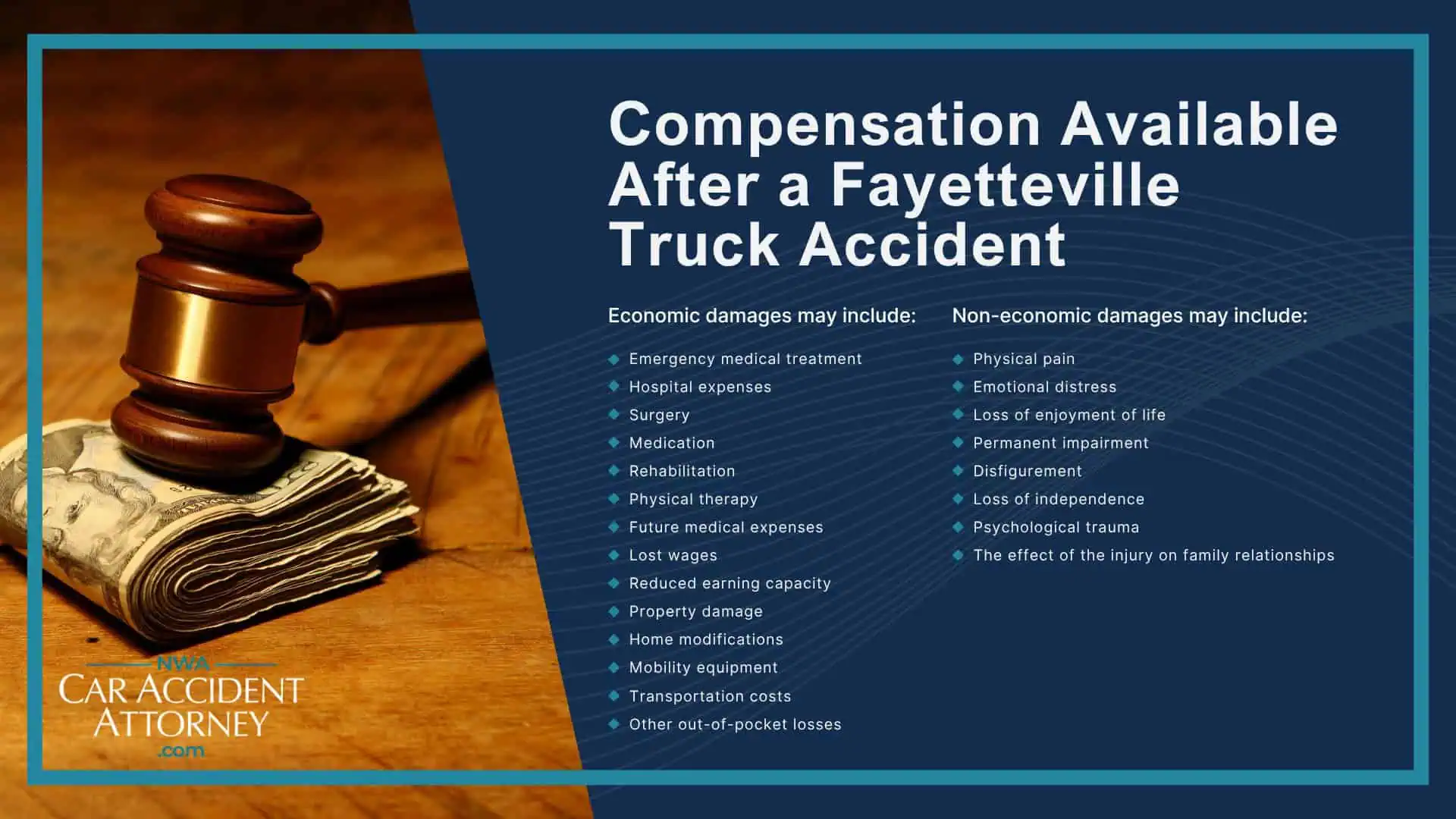
Economic damages may include:

  • Emergency medical treatment
  • Hospital expenses
  • Surgery
  • Medication
  • Rehabilitation
  • Physical therapy
  • Future medical expenses
  • Lost wages
  • Reduced earning capacity
  • Property damage
  • Home modifications
  • Mobility equipment
  • Transportation costs
  • Other out-of-pocket losses

Non-economic damages may include:

  • Physical pain
  • Emotional distress
  • Loss of enjoyment of life
  • Permanent impairment
  • Disfigurement
  • Loss of independence
  • Psychological trauma
  • The effect of the injury on family relationships

Punitive damages may be considered in limited cases involving especially reckless or malicious conduct.

No lawyer can guarantee a particular result, but experienced counsel can document current and future losses and pursue compensation supported by the evidence.

Wrongful Death Claims After Fatal Truck Accidents

Truck accidents involving large trucks and semi trucks can result in fatal crashes.

When a person dies because of another party’s negligence, the family may have the right to pursue a wrongful death claim under Arkansas law.

Arkansas Code § 16-62-102 permits a wrongful death action when death is caused by a wrongful act, neglect, or default that would have allowed the person to bring a personal injury claim had the person survived.

A wrongful death claim may seek compensation for:

  • Funeral and burial expenses
  • Lost income and financial support
  • Loss of services
  • Loss of companionship
  • Mental anguish
  • Other damages allowed by Arkansas law

Under Arkansas law, a wrongful death action is generally brought by the deceased person’s personal representative.

If no personal representative exists, the heirs at law may bring the action. The ordinary deadline is three years from the date of death.

A related survival claim may address qualifying losses belonging to the deceased person or estate.

A fatal truck accident case may involve the truck driver, trucking company, equipment owner, maintenance provider, cargo company, or multiple parties.

An Arkansas truck accident attorney can explain who may bring the claim and what evidence must be preserved.

How Long Do You Have to File a Truck Accident Lawsuit in Arkansas?

Arkansas Code § 16-56-105 generally establishes a three-year limitations period for many actions involving injury to a person or property.

As a result, many truck accident lawsuits must be filed within three years, although the correct deadline depends on the facts and parties involved.

Different or shorter requirements may apply when:

  • A government entity is involved
  • A public employee or contractor contributed to the crash
  • The injured person is a minor
  • The case involves wrongful death
  • A defendant leaves the state
  • A particular insurance policy imposes notice requirements

Waiting can also weaken a case before the legal deadline expires.

Truck data may be overwritten, records may be destroyed under retention policies, vehicles may be repaired, and witnesses may become harder to locate.

A Fayetteville truck accident lawyer can identify the applicable deadline and begin preserving evidence promptly.

How a Fayetteville Truck Accident Lawyer Can Help

A Fayetteville truck accident lawyer can investigate the collision, deal with trucking insurers, and build a claim against every responsible party.

This work may involve far more than reviewing the police report.

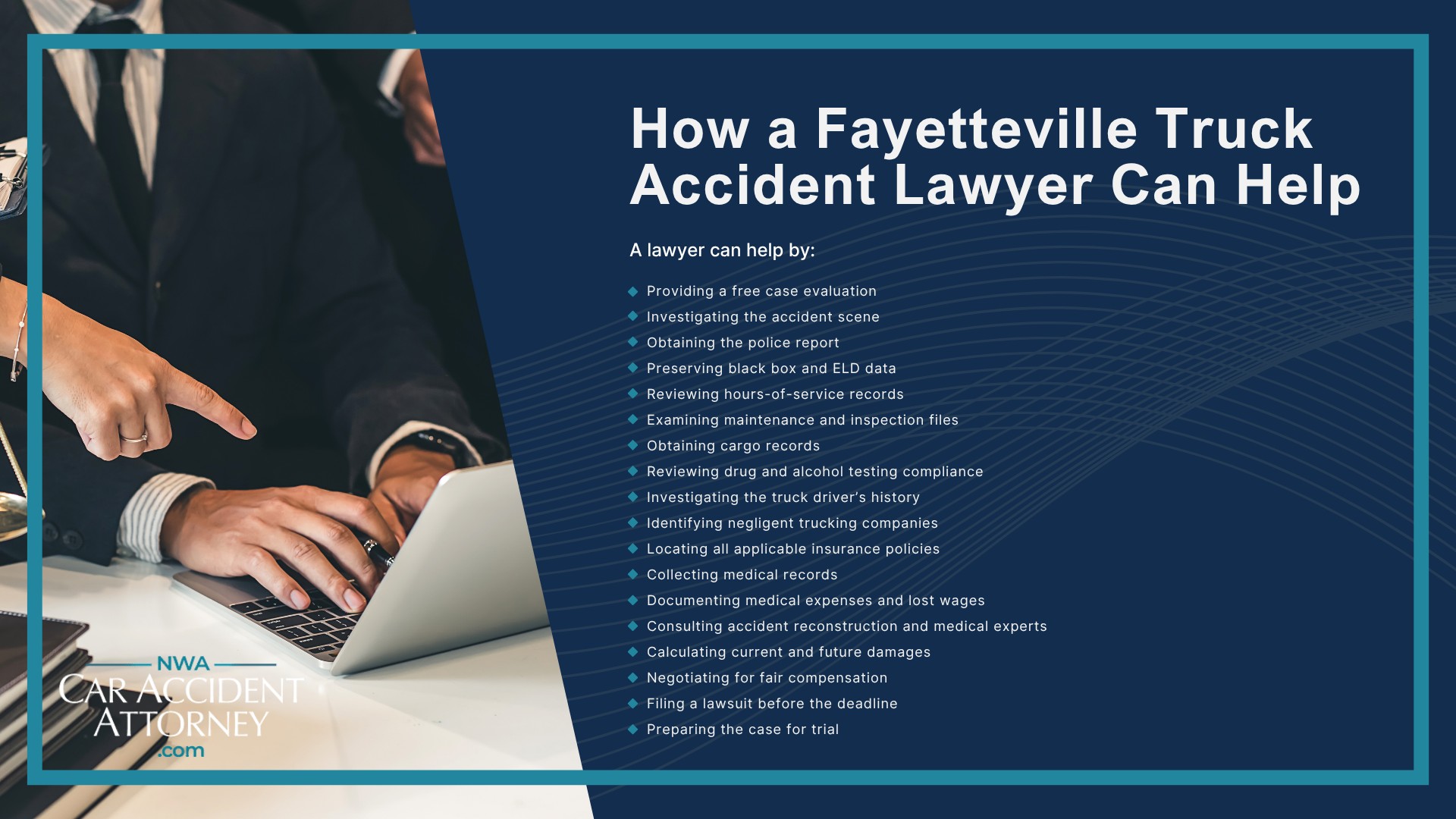
A lawyer can help by:

  • Providing a free case evaluation
  • Investigating the accident scene
  • Obtaining the police report
  • Preserving black box and ELD data
  • Reviewing hours-of-service records
  • Examining maintenance and inspection files
  • Obtaining cargo records
  • Reviewing drug and alcohol testing compliance
  • Investigating the truck driver’s history
  • Identifying negligent trucking companies
  • Locating all applicable insurance policies
  • Collecting medical records
  • Documenting medical expenses and lost wages
  • Consulting accident reconstruction and medical experts
  • Calculating current and future damages
  • Negotiating for fair compensation
  • Filing a lawsuit before the deadline
  • Preparing the case for trial

Truck accident cases require knowledge of Arkansas law, federal trucking regulations, commercial insurance, and industry evidence.

An experienced attorney can protect the victim’s rights while the victim focuses on recovery.

Why Choose NWA Car Accident Attorney?

People injured in a truck crash need a law firm prepared to deal with commercial carriers and their insurers.

NWA Car Accident Attorney assists clients in Fayetteville and throughout Northwest Arkansas with serious motor vehicle and truck accident claims.

Our approach includes:

  • Prompt investigation of the crash
  • Attention to federal trucking laws
  • Preservation of electronic and company records
  • Review of every potentially liable party
  • Detailed documentation of injuries and losses
  • Direct communication with clients
  • Negotiation with commercial insurance companies
  • Preparation for litigation when a fair settlement is not offered

Our truck accident attorneys handle claims on a contingency fee basis.

Clients do not pay upfront attorney’s fees, and attorney’s fees are owed only if the firm recovers compensation.

The representation agreement should explain the fee percentage and responsibility for case expenses.

No law firm can promise a particular result.

Our team can pursue the evidence, protect your legal rights, and fight for the compensation supported by your case.

NWA Car Accident Attorney: Talk to a Fayetteville Truck Accident Lawyer Today

If you were injured in a truck accident in Fayetteville, you may be facing severe injuries, medical bills, lost wages, vehicle damage, and pressure from trucking company insurers.

You do not have to handle the process alone.

NWA Car Accident Attorney can investigate the truck driver, trucking company, vehicle maintenance, cargo loading, electronic records, and insurance coverage.

Whether your case involves a semi truck accident, fatigued driving, reckless driving, improperly loaded cargo, defective truck parts, or wrongful death, our legal team can explain your options.

Contact NWA Car Accident Attorney today for a free consultation with a Fayetteville truck accident lawyer.

You may also use the chat feature on this page for a free case evaluation.

Our firm represents truck accident victims on a contingency fee basis.

You pay no upfront attorney’s fees, and attorney’s fees are owed only if we recover compensation for you.

Frequently Asked Questions

Published by:
Share

This article has been written and reviewed for legal accuracy and clarity by the team of writers and attorneys at NWA Car Accident Attorney and is as accurate as possible. This content should not be taken as legal advice from an attorney. If you would like to learn more about our owner and experienced injury lawyer, Sean T. Keith, you can do so here.

NWA Car Accident Attorney does everything possible to make sure the information in this article is up to date and accurate. If you need specific legal advice about your case, contact us. This article should not be taken as advice from an attorney.

Additional Motor Vehicle Accidents resources on our website:
All
Car Accidents
Motor Vehicle Accidents
Motorcycle Accidents
Truck Accidents
Uber Accidents
Other cases we handle in Fayetteville
Fayetteville Car Accident Lawyer
Fayetteville Motor Vehicle Accident Attorney
Fayetteville Motorcycle Accident Lawyer
Fayetteville Uber Accident Lawyer

Other Fayetteville Personal Injury Cases

All
Car Accidents
Motor Vehicle Accidents
Motorcycle Accidents
Truck Accidents
Uber Accidents
Local Fayetteville Resources
Education
Emergency Services
Courthouses
Department of Motor Vehicles
Sights to See
Counties
Body Shops
Chiropractors